The Roadless Rule Is at a Crossroads. Here’s How You Can Help.
Already know the issue and ready to speak up?
Skip straight to the comment builder → In about two minutes, you can turn your own experiences and concerns into a unique comment to USDA.
What’s Happening to the Roadless Rule?
For 25 years, the Roadless Area Conservation Rule has provided a consistent national framework for protecting some of the wildest remaining lands in our National Forests. Along the Pacific Northwest Trail, Inventoried Roadless Areas help conserve intact wildlife habitat, clean water, opportunities for backcountry recreation, and the wild character that makes the PNT extraordinary.
Now, the future of those protections is uncertain.
On August 20, the U.S. Department of Agriculture published a proposed rule that would rescind the 2001 Roadless Rule. If finalized, the proposal would remove national protections that generally prohibit new road construction and timber harvest within Inventoried Roadless Areas, subject to important existing exceptions.
USDA argues that rescinding the rule would give local Forest Service officials greater flexibility to manage National Forest lands, including for wildfire risk reduction and timber production.
PNTA believes eliminating the national rule is the wrong approach.
Why Roadless Areas Matter
The Roadless Rule does not prohibit all forest management, nor does it prevent the Forest Service from responding to wildfire, addressing threats to public safety, or undertaking many kinds of forest restoration work. Instead, it establishes a national safeguard against the fragmentation of some of our most intact National Forest lands. By limiting new roads and associated development, the rule helps conserve large, connected habitats, healthy watersheds, and places where natural processes can continue with less disturbance.
Rescinding the rule would leave more decisions about road construction and timber harvest to local Forest Service officials. But those decisions would not occur in a vacuum. Local officials work within an agency whose priorities are set by national leadership—and those priorities can shift significantly from one presidential administration to the next.
That distinction matters. “Local control” can sound like these decisions would simply be handed to local communities or states. They would not. Removing the national baseline could instead leave decisions about roadless lands more exposed to changing political priorities, pulling local decision-makers in different directions as administrations change.
The current moment illustrates that concern. The administration has made substantially increasing timber production from National Forest lands an explicit priority. Removing the Roadless Rule while that directive is in place creates a real risk that currently roadless lands will face greater pressure for road construction and commercial harvest.
The Roadless Rule provides something different: a consistent national baseline that persists as administrations and management priorities change, while still allowing exceptions for legitimate management and public-safety needs.
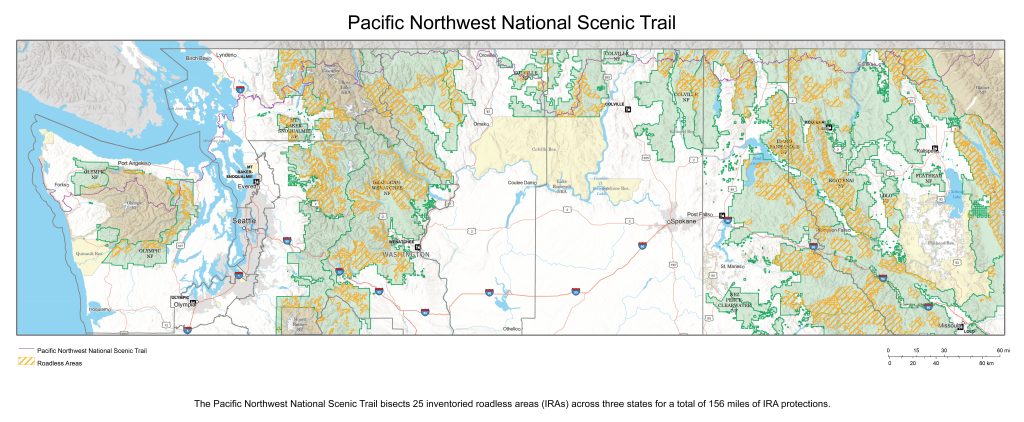
For the Pacific Northwest Trail, that consistency is especially important. The PNT passes through 25 Inventoried Roadless Areas across Washington, Idaho, and Montana, with approximately 156 miles of the trail within areas protected by the Roadless Rule. These landscapes illustrate something fundamental about the PNT: the trail is not only a recreational route through the Northwest, but a way for people to experience an extraordinary network of wild places. Conserving the landscapes surrounding the trail is inseparable from protecting the experience the trail was created to provide. Inventoried Roadless Areas help maintain wildlife habitat, watershed health, landscape connectivity, and opportunities for primitive recreation along the PNT.
The Forest Service Already Has an Enormous Road System
The question isn’t whether National Forests should have roads. Roads provide important access for recreation, forest management, rural communities, firefighting, and many other uses.
But the Forest Service already manages more than 375,000 miles of roads—substantially more road mileage than the entire National Highway System, including the Interstate Highway System.
And the agency is already struggling to maintain them.
The Forest Service reports nearly $6 billion in deferred maintenance on its existing roads, plus nearly $1 billion more for road bridges. Even that doesn’t capture the entire system: the agency says it cannot reliably estimate deferred maintenance for its high-clearance vehicle and basic custodial-care roads, so those roads aren’t included.
This raises an important question:
Does it make fiscal or conservation sense to expand a road network the Forest Service already struggles to maintain?
Roads aren’t simply a one-time construction expense. They become long-term infrastructure requiring drainage, culvert replacement, bridge work, maintenance, reconstruction and, eventually, decommissioning. Poorly maintained roads can also become environmental liabilities, contributing sediment to waterways and degrading fish and wildlife habitat.
Before eliminating protections for lands that remain roadless, USDA should fully account for those long-term costs.
What About Wildfire?
USDA has also argued that rescinding the Roadless Rule would provide greater flexibility to reduce wildfire risk.
Wildfire is an increasingly serious challenge across the West, and land managers need the tools to protect communities and restore forest health. But the Roadless Rule already contains exceptions that allow roads to be constructed when necessary to protect public health and safety, including in response to wildfire and other catastrophic events. It also allows many activities intended to improve habitat or ecological conditions.
USDA should demonstrate why these existing authorities are insufficient before removing protections from tens of millions of acres of National Forest lands.
The relationship between roads and wildfire also deserves careful consideration. Roads can provide access for firefighters and forest-management activities, but increased road access also creates additional opportunities for human-caused wildfire ignitions.
The question isn’t simply whether roads can be useful for wildfire management. It’s whether eliminating the Roadless Rule across tens of millions of acres is necessary to accomplish that work—and whether the benefits outweigh the fiscal and environmental costs of expanding the National Forest road network.
Tell USDA What You Think
USDA is accepting public comments on its proposal to repeal the 2001 Roadless Area Conservation Rule through October 6, 2026.
PNTA opposes repeal of the Roadless Rule and encourages USDA to retain the rule by selecting the No Action Alternative.
The best comment is one that comes from you. If you’re ready to write your own, tell USDA why roadless National Forest lands matter to you, what concerns you about the proposed repeal, and what you want the agency to do.
Short on time? Let us help. Answer a few simple questions below and write as little as two sentences in your own words. We’ll turn your answers into a unique draft comment that you can review and edit before submitting it.
Build a Unique Roadless Rule Comment
Short on time? Choose one issue and write just two sentences in your own words. Want to say more? Select additional issues and we'll walk you through them.
USDA is accepting public comments on the proposed repeal of the 2001 Roadless Area Conservation Rule through September 21, 2026.
Privacy: Nothing you type here is sent to PNTA or USDA. This tool runs entirely in your browser.
1. Tell USDA who you are
2. Why do these lands matter to you?
3. What concerns you about repealing the Roadless Rule?
Choose at least one. If you want to keep this quick, choose the issue that matters most to you. If you want a more detailed comment, choose as many as you like—we'll ask for one sentence about each.
4. What should USDA answer before making its decision?
Choose the question you most want USDA to answer. This step does not require any writing.
5. Build your comment
Your Draft Comment
Opening Regulations.gov does not automatically submit your comment. Paste your draft into the federal comment form, review it one more time, and complete the submission there.
Docket: FS-2025-0001
RIN: 0596-AD66
Comment deadline: September 21, 2026
What We Choose to Leave Roadless
The debate over the Roadless Rule is about more than one regulation. It is about how we decide which parts of our National Forests should remain substantially undeveloped—and whether some places are valuable precisely because we have chosen not to build roads into them.
Roadless areas are not untouched places, and keeping them roadless does not mean putting them off limits to people or preventing their management. It means recognizing that roads fundamentally change landscapes—and that there is value in maintaining some of our National Forests without them.
Once a road is built into one of those landscapes, that decision can be difficult to undo.
The Pacific Northwest Trail is both a pathway through the Northwest and a connection of its wildest places. Its value depends not only on having a trail to travel, but on conserving the landscapes that make that journey extraordinary. The decisions we make about roadless lands today will help determine what kind of landscape future generations inherit.
Submit your comment to USDA by October 6 and ask the agency to retain the 2001 Roadless Area Conservation Rule and select the No Action Alternative.